

Since this publication began circulation in August, we have received several letters from concerned readers who claim that we are misleading the public about the location (current and historical) of Chronicle. This paper has always maintained that Chronicle is centered on the intersection of NC-150 and NC-16 (known today as Killian Crossroads).
One dissenting letter reads in part, “You are off by approximately one mile … I roamed the woods, fields, and roads all my life, built two houses, raised a family, and we did not know [Killian Crossroads] as Chronicle at all. That name was reserved for the intersection of Lebanon Church Road and Mountain View Baptist Church Road.”
There is merit to the claims made by the authors of these letters. Since Chronicle never had an “official” town center, its precise location and boundaries are ambiguous. In the past, locals, newspapers, and mapmakers often marked the center of Chronicle by the location of the now-defunct Chronicle Post Office.
Thus, to determine the location of Chronicle, one must examine the historical location of the Chronicle Post Office.
This task is more difficult than one might initially assume. In the 1800s, rural areas (including most of Catawba and Lincoln counties) were served by “fourth-class” post offices. This was the lowest class of post office offered by the US Post Office Department (now the United States Postal Service).
A 2019 historical report published by the United States Postal Service reads, “Mail would arrive by post road at “fourth-class” post offices in nearly every village. These were not post offices in the modern sense. In the vast majority of cases they were simply a part of the local general store, newspaper publisher, similar business establishment, or even a private residence. By 1891, over 60,000 fourth-class post offices dotted the countryside.”
Records of these post offices and their locations were not well kept, and few survive to modern day. Further complicating the matter, because fourth-class post offices were part of existing businesses or residences, the location of those post offices would often change when a new postmaster was appointed. This could result in entire towns appearing to move miles in historic records and maps.
For example, the first post office at Dry Pond was established in 1836. During the mid to late 1800s, the post office was sporadically located in Catawba County, just north of the county line, before returning to Lincoln County permanently in 1874 with the new name “Denver.”
The book “A History of Catawba County,” published by the Catawba County Historical Association, lists eleven known individuals who served as postmaster during the existence of the Chronicle Post Office. While the post office did not necessarily move every time a new postmaster was appointed, it is possible that, between the 1850s and 1903, the post office existed in eleven different locations.
The first Chronicle Post Office was established in 1851 (or, some sources say, 1857) in Lincoln County, just south of the Catawba County border.
Though records of the post office’s exact location are sparse, maps on the historical encyclopedic research website carolana.com place it south of Killian Crossroads.
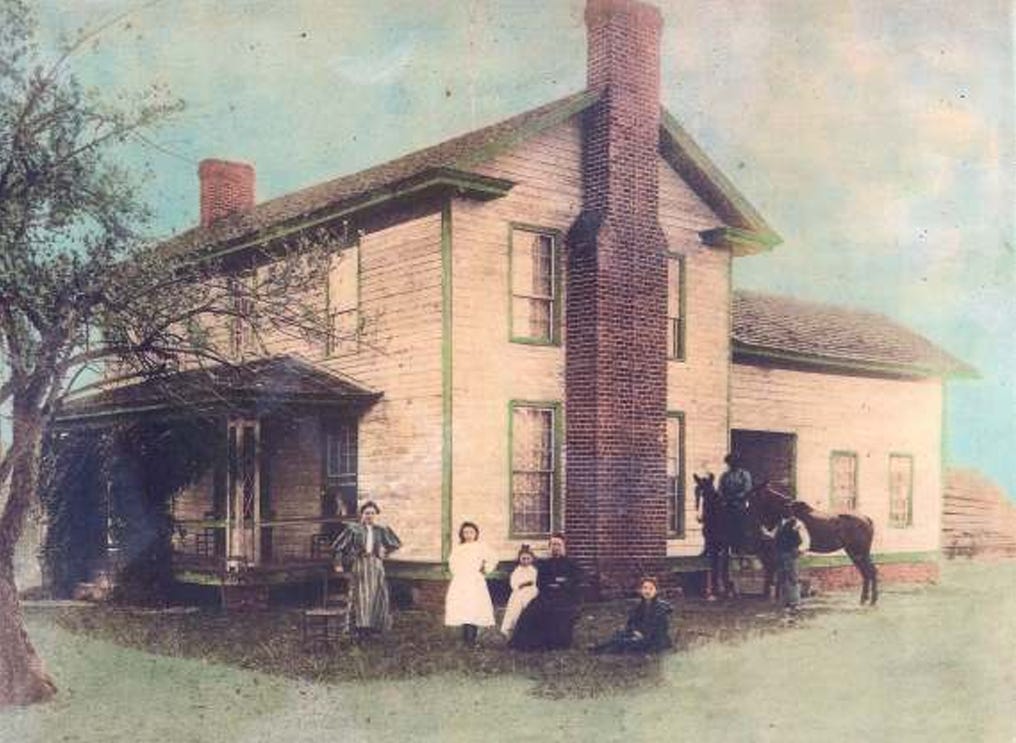
Osborne Munday (sometimes spelled Mundy) served for years before the Civil War as the first Chronicle postmaster. In the 1850s, Osborne constructed what is now known as the Mundy House, a bi-level home located on NC-16 Business just south of the Lincoln County border. The site is currently managed by the East Lincoln Historical Society and is listed on the National Register of Historic Places.
The Mundy House likely served as the first location of the Chronicle Post Office, and the only location still standing today.
The Chronicle Post Office in Lincoln County was discontinued in 1866 before being moved to an unknown location in Catawba County in 1869.
The location of the most well-known Chronicle Post Office in Catawba County is gleaned from the famous Yoder Map.
Printed in 1886 by Robert Anderson Yoder, the map is one of few primary sources from the time. In Yoder’s 1911 obituary, a newspaper wrote, “the deceased minister was for ten years or more president of Lenoir college at Hickory” and called his 1886 map, “the first and only map of Catawba County, a fine piece of work.”
The map is detailed, noting townships, cities, roads, waterways, mountains, and even the homes and businesses of prominent county residents. Included on the map is the exact location of “Dellinger’s Store & Chronicle P.O.,” a combined entity that, for an unknown number of years, became the center of Chronicle.
This particular iteration of the Chronicle Post Office, according to the map, was located on the north side of what is today E Maiden Road, near where it intersects Mountain View Church Road.
The post office location marked on the Yoder Map is only one-half mile down the road from the location suggested by some of our readers.
The Chronicle Post Office was discontinued in 1904, two years after the Postal Department began nationally delivering mail to homes in rural areas.
If there is no known post office that existed at Killian Crossroads, why does this newspaper refer to that intersection as the center of Chronicle?
Most maps of Catawba County and surrounding areas between the 1930s and 1980 label the intersection “Chronicle.” As recently as 2010, some NC Department of Transportation maps continued to mark the intersection “Chronicle.”
A 1938 map of Catawba County, published by the North Carolina State Highway and Public Works Commission, is the earliest known map that refers to the intersection of NC-16/NC-150 as “Chronicle.”
Why this change occurred is a matter of speculation. Perhaps the people of Chronicle began to refer to the more-developed intersection as the center of town. Perhaps the government made a mistake when drawing their maps. Perhaps, between the making of the 1886 Yoder Map and the discontinuation of the Chronicle Post Office in 1904, the post office was moved to the intersection.
Regardless of how it occurred, Killian Crossroads has been considered the center of Chronicle for nearly a century. This newspaper will continue to refer to the intersection as such in the interest of historical accuracy and modern practicality.
We are, however, fallible, and appreciate the input of readers who may have additional information.
If you possess historical documents, photographs, family stories, or any other information on the history of Chronicle, please reach out via email or social media, or send us a letter through the mail. Your research will be credited and your knowledge will be shared with all of our readers.
Any information can be helpful, even apocryphal oral histories passed down from previous generations. With your help, we will continue to chronicle our community’s past, present, and future.
I believe Mr. Yoder‘s map is correct for the placement of the chronicle post office. My maternal grandmother’s family the Hicks lived in that area from the early 1800s until present time. I remember specifically discussing this with my great uncle Elbert Pinkney Hicks who lived on what is now Buck’s garage Road. He was born in 1890 and died in 1978. The post office at chronicle would have been there until he was 14 years old. In addition, his older brother and two older sisters had memories of it as well. My great grandfather. Adolphus. Pinckney Hicks owned approximately 300 acres in the area. Near the foot of Little Mountain from the present day business Highway 16. Bucks garage Road initially was his wagon road to his fields. 200 acres of that was divided into four equal tracks of 50 acres each to his four sons. No one in our family or our neighbors ever referred to the intersection of what is Highway 16 and 150 as chronicle. Also, if you review the 1886 Yoder map near the location for chronicle is listed M Hicks store. That belonged to my great grandfather’s older half brother. My great grandparents and nine of their children are all buried at Mountain View Baptist Church. The 10th member of the family is buried at Lebanon Methodist church.
I can also tell you that in the early 1920s when the mail was being delivered from Maiden Post Office, the mail carrier was named Jarvis Wilkinson. He once asked one of my grandmother’s cousins to tell her that she was the best damn looking woman in Catawba County. The cousin who was asked to deliver the message had a crush on him so she was disheartened when he said.
I know I have rambled, but to reiterate, I have never heard anyone extend the name of chronicle to cover all the way over to Highway 16 and 150 intersection