

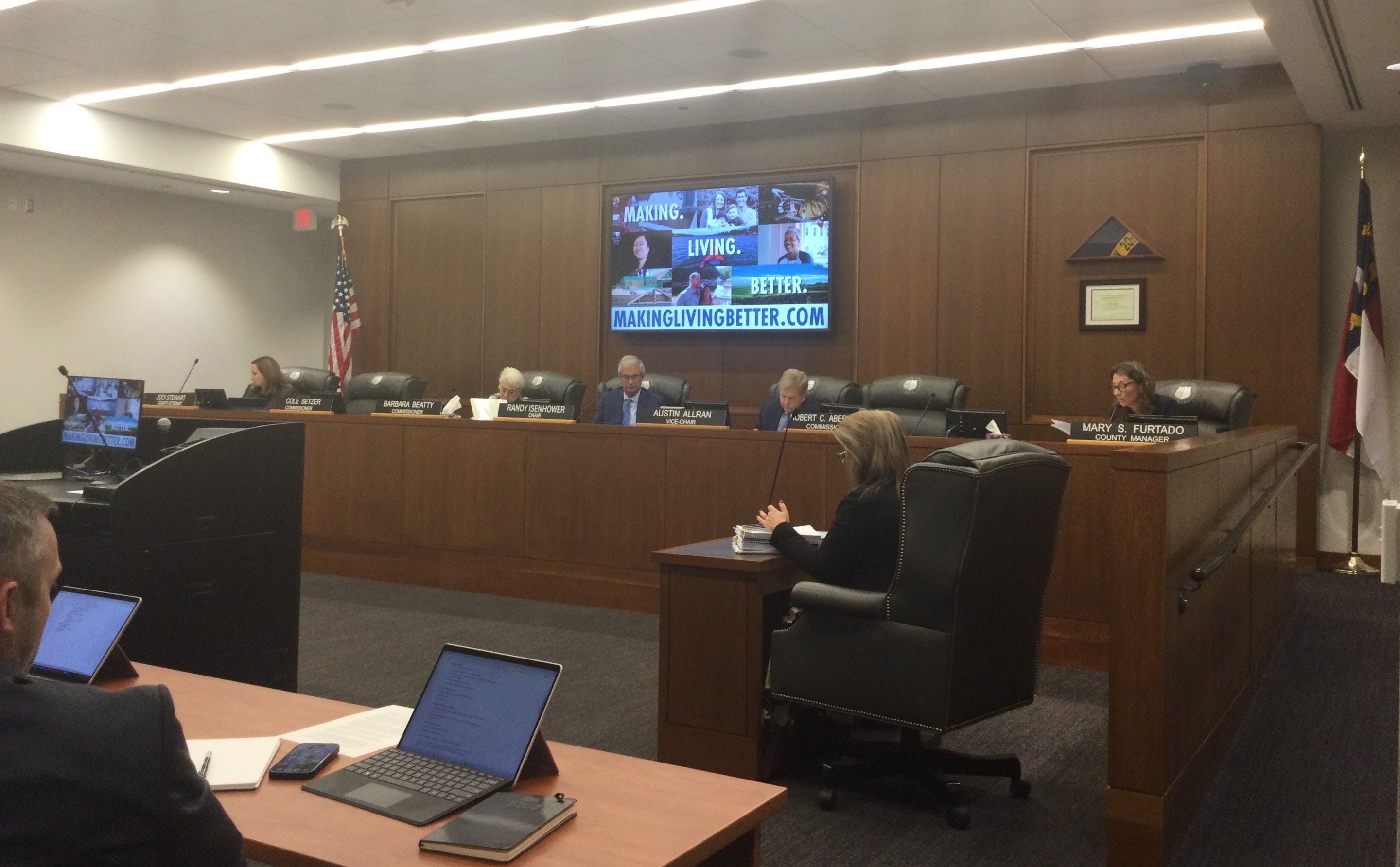
The Catawba County Board of Commissioners voted to adopt a revised Unified Development Ordinance (UDO) at their regularly scheduled meeting on October 19th.
The vote also directed staff to pursue a study on short-term rentals such as Airbnb and Vrbo in the county after significant pushback from the community.
Chair Isenhower, Vice Chair Allran, and Commissioner Beatty voted unanimously in favor of the approval. Commissioners Abernethy and Setzer were not present at the meeting.
The planning board had previously voted to recommend adoption of the UDO without a proposed revision addressing short-term rental issues.
The unified development ordinance is a legal document which regulates land use, zoning, and development within the unincorporated areas of Catawba County.
It differs from the comprehensive plan adopted in 2024, which the county describes as “an expression of the community’s vision for Catawba County over the next 15 years or so.”
The approval comes after a public input forum, two public drop-in sessions, and a public planning board hearing.
“The purpose of the update to this UDO is to reflect the goals of that adopted 2024 comprehensive plan, to address current development challenges, [and] to align with recent updates within the North Carolina General Statutes,” Catawba County Planning Director Chris Timberlake said at the October meeting.
The planning staff recommended against a proposed set of rules for short-term rental properties that would have regulated occupancy, parking, advertising, and events, arguing that any provisions put in place would not apply to existing short-term rentals, creating an “uneven playing field.”
Legal staff also advised against taking immediate action, citing current pending litigation regarding the issue in surrounding counties.
“There’s just a lot of flux right now and in the law related to this situation,” County Attorney Jodi Stewart said at the meeting. “It would be helpful to let some of this settle out and it would help us to make decisions based on how these other lawsuits resolve.”
Several individuals from the Moonlite Bay (sometimes spelled Moonlight Bay) community and the surrounding area spoke against the revised UDO, citing issues with short-term rental properties.
The community lies on the banks of Lake Norman just off of Slanting Bridge Road, between Denver and Terrell in a location historically known as Flemmings or Keistlers Crossroads.
A local real estate company describes the neighborhood on their website.
“This picturesque neighborhood, located in Catawba County, offers a serene lakeside lifestyle that many dream of. With its charming community vibe and stunning natural surroundings, Moonlite Bay is the perfect place for families, retirees, and anyone looking to enjoy the tranquility of waterfront living.”
According to the residents, numerous neighborhood homes have been purchased over the course of several years and repurposed into short-term rentals.
“[Our neighborhood] has 30 homes, of which 11 are now short-term rental units,” one Moonlite Bay resident told the board. “This has had a dramatic and adverse effect on our community.”
Complaints focused on several issues, including the number of guests in each of the rentals.
“How can you have a five-bedroom home and have 22 people staying there?” one Moonlite Bay resident said. “That’s four people per bedroom. That’s kind of sick, if you ask me.”
The number of guests, residents claim, has led to noise ordinance violations, illegal parking, trespassing, and dangerous misuse of community resources.
“When all of these [rentals] are occupied during the summer or during the holidays, what you’ve done is taken an established neighborhood and turned it into a resort,” one resident said. “What happened to the permanent residents’ property right to quiet and peaceful enjoyment? These people are suffering.”
Residents say they have contacted the sheriff on several occasions to address the issues, but described mixed results.
One woman described a drunk couple arguing outside her bedroom window at midnight while her husband was not home.
“I didn’t call the cops. I didn’t. Because I fear what [the renters] are going to do after the cops show up. We had one time we called the sheriff, next door was raising Cain at midnight. Well they started pointing fingers at our house. … There’s no regulations on knowing anything about who’s renting that property next door. You don’t know if they have their convicted felons … if they’re rapists. That’s not fair to people that have to live and listen to them.”
Other residents described similar safety concerns.
“We have a beautiful beach that is just the Moonlite Bay beach, and my grandchildren go there,’ one resident said. “My daughter won’t take them anymore because of the boats that don’t adhere to the [wake] zone.”
Because Moonlite Bay does not have a homeowner’s association and does not lie within a municipality, the county is the only administrative body that can regulate short-term rentals in the community.
“They’re targeting neighborhoods without HOAs,” she said. “You can’t put an HOA in now because it won’t be retroactive to prevent this from continuing. They’re stuck. They have no options, and if you keep on letting this happen, it’s going to eradicate your housing market. It’s not only a North Carolina problem; this is an international problem.”
The alleged issues caused by the short-term rentals are not confined to the Moonlite Bay community.
“[I am] not a part of this neighborhood, but [I live] across the cove and 500 yards from the lake,” a woman told the commissioners. “I hear the noise from all of these homes repeatedly. We have had instances of these guests trespassing on people’s property, urinating in their yards, fishing off their docks.”
Similar problems have occurred in other counties in North Carolina. A speaker from Iredell county described his experience with short-term rentals, and argued that short-term rental properties should be regulated more similarly to commercial property.
“Catawba County, like Iredell, is not collecting any occupancy taxes from these Airbnbs,” he said. “We found that most of those Airbnbs are not applying for permits for upgrades or additions, are not getting inspections for the work being performed, are not registered with the state, are not paying taxes on extra bedrooms, are not paying occupancy taxes, but are overselling beds for heads.”
Residents of the area argued that their concerns had been largely ignored.
“I met with Mr. Timberlake and Ms. LoCicero a couple of weeks ago to discuss why the county in this revised UDO is not addressing these [issues],” said Robert Grant, an attorney representing clients from a community adjacent to Moonlite Bay. “With all due respect to them, what I heard was, well, it’s hard. It’s hard to regulate … The fact that there’s potential litigation is not a reason to shrink away from doing what’s right.”
Following the public comments, the board deliberated on the issue.
“I struggle with the staff recommendation with regard to the short-term rentals,” said chairman Isenhower, garnering applause from the residents in the crowd. “I’m really not ready to foreclose the UDO not addressing short-term rentals.”
Co-chair Allran added, “This is new stuff to me, as far as hearing people. It sounds awful.”
After discussion between the commissioners, county attorney, county manager, and planning director, the board moved to pass the revised UDO as written but to direct the planning department to conduct a further study on short-term rentals.
“There’s a problem that’s not being addressed and it sounds like we don’t know how to address it,” said Co-chair Allran. “[We’d] better study it and figure out how to do it.”
The move passed with the unanimous consent of the three commissioners present.
The move drew mixed responses from the attending residents. The measure received applause upon passing. One resident remarked that relying solely on a study would result in the issue being ignored.
The revised UDO took effect on October 20th.
Other notable changes include minor edits to grandfather clauses and regulatory changes to the size of accessory structures.
The full text of the revised UDO is available on Catawba County’s website.