

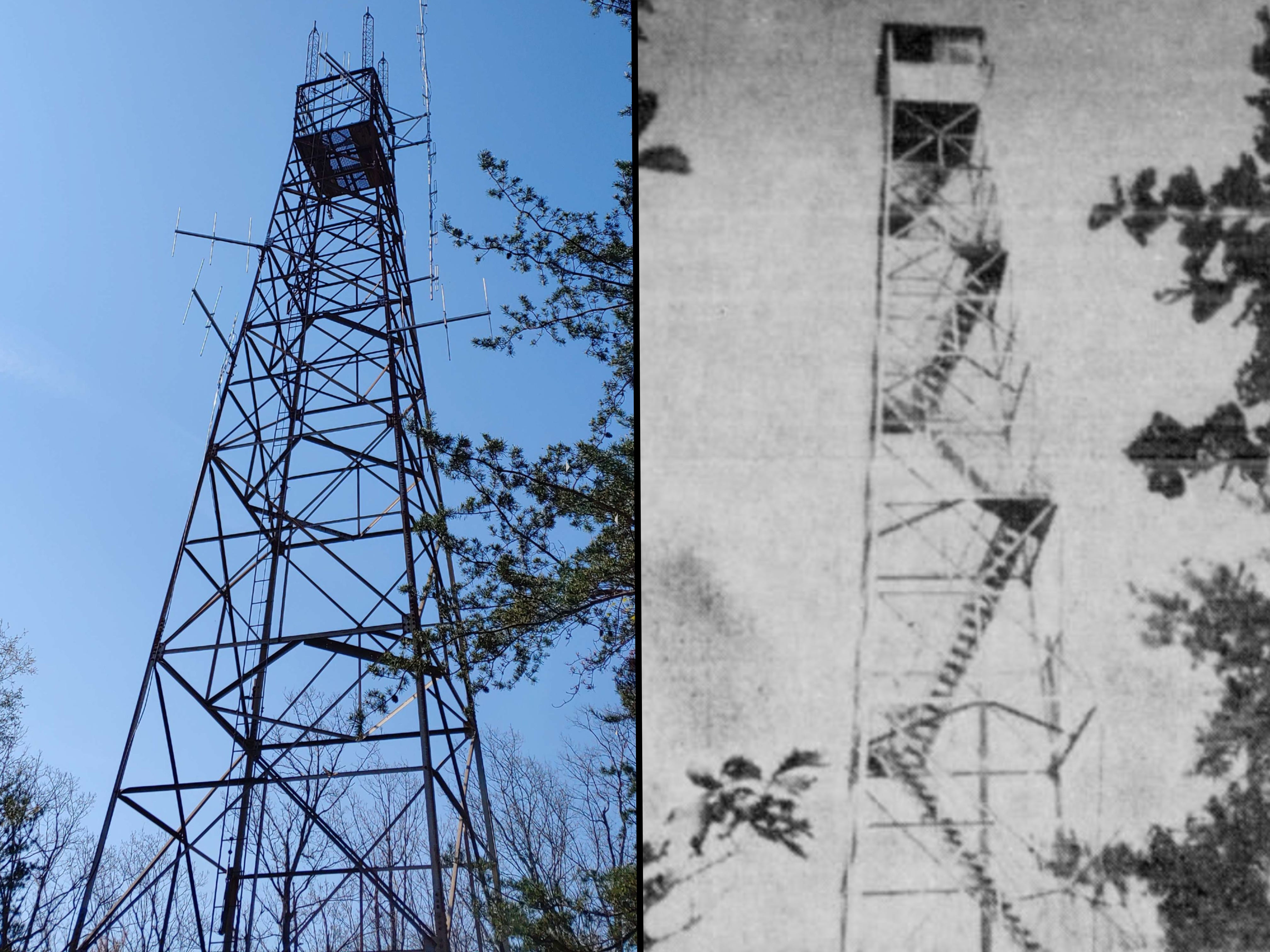
Prior to 1950, the only man-made structures on Anderson Mountain were a few scattered homes and the remnants of gold and iron mines dating to the prior century’s gold rush (see our article on Anderson Mountain in the Carolina Gold Rush).
The highest peak of the mountain was especially neglected. Too far off of the beaten path to be lucratively developed for most of Catawba County’s history, it sat mostly undisturbed.
Things began to change in 1943, when Vernon Otto Sipe purchased most of the ridge of Anderson Mountain. Sipe, a well-respected orchardist native to Conover, is today primarily remembered for founding Sipe’s Orchard Home, a children’s home operated out of his orchard.
Sipe owned the land for seven years before finalizing his development plans and submitting them to the county in 1950. He envisioned a one-hundred-unit development, featuring both residential homes and commercial establishments, running along Anderson Mountain’s ridge on the west side of NC-16 and spilling out along the highway.
Advertisements published by Sipe in the Hickory Daily Record suggested that a motor court (a 1950s style motel) would be built on a knoll overlooking NC-16, and an artificial lake “fed by spring water” would be constructed between the motor court and the highway.
The development, named Anderson Park after the mountain, was advertised as having the “nicest mountain home sites, closer than Chimney Rock or Blowing Rock … the lots overlook the whole countryside.”
Sipe also proposed that a Western Union tower be built at the mountain’s peak, alongside a fire prevention tower. A road was cut for the first time along Anderson Mountain’s ridge. It came to be known as Lookout Tower Road, today abbreviated Tower Road.
Sipe attempted to auction the land to builders in 1950, but saw limited success. The majority of the property on Tower Road remained undeveloped until doublewide communities were installed in the 1990s, decades after Sipe’s death. Much of the land along Tower Road is still undeveloped today.
However, Sipe did live to see one aspect of his vision realized: a fire prevention tower was built at the peak of Anderson Mountain.
In the early to mid 20th century, forest fires were a major problem in rural areas. Lack of reliable methods of communication meant that fires would blaze out of control for hours or even days before being reported to the authorities. Even if a fire was spotted, the average citizen was not always in range of a telephone.
Fire towers (also called lookout towers) alleviated this problem by stationing rangers at high vantage points. From the lookout towers, usually built atop existing hills and mountains, rangers were able to see and pinpoint the location of fires with never before seen speed and accuracy. Using telephone lines or radio equipment built into the towers, the rangers could then quickly alert local fire response teams. This method of fire prevention was utilized across the United States.
The fire tower atop Anderson Mountain, the first and only tower ever built in Catawba County, was completed in early 1951. The only tower built entirely of wood in North Carolina, it was supported by four telephone poles. Less than thirty feet tall, it was far shorter than most fire towers in the state.
Along with a network of four other towers in surrounding counties, the Anderson Mountain tower provided a view of the entirety of Catawba County. In ideal conditions, the towers would cooperate via radio to triangulate the position of forest fires.
Jim Ledbetter was the county forester in the early 1950s, responsible for the preservation of the over one hundred thousand acres of forest that existed in Catawba County at the time. As part of his duties, he was also responsible for the maintenance and staffing of the tower. He inherited the project from his predecessor Hampton Johnson, who had retired immediately after construction of the tower was completed.
Johnson advocated that he be quickly replaced and told reporters, “The job is by no means complete.”
He was correct. The lookout tower did not yet have a radio or a telephone, limiting the effectiveness of its primary function. A frustrated Ledbetter frequently told newspapers that the tower would be effective just as soon as it was fully equipped.
Ledbetter’s department had the money neither for the equipment, nor for the full-time staff to use it.
When a radio was finally purchased in October of 1952, it cost so much that the tower was forced to close down for the fall fire season.
The radio and a telephone line were finally installed in early 1953. At the same time, Ledbetter and the county were able to scrounge together funds for a full-time staff. With the tower fully operational, Ledbetter and his crew were finally able to begin putting a stop to forest fires.
Ledbetter and his staff also sent out open invitations to the public on several occasions, encouraging them to visit the tower and enjoy the views. Many individuals took him up on this offer, especially the after-church crowd.
One particularly gleeful Hickory Daily Record reporter described the journey up Anderson Mountain (which he called “Ol’ Andy”), driving past signs for the never-to-be Anderson Park and up the then-unpaved Tower Road. Despite unusually foggy conditions, he claimed that the view was amazing.
“Gazing out the windows, one feels he is the owner of all he sees,” the reporter wrote. “The numerous farms and fields make patterns on the landscape like pieces of a puzzle, and the fresh, cool air takes your breath.”
In 1954, a new steel tower was built to replace the wooden tower. The new tower, seventy-two feet tall, rose above the treeline, providing better, unobstructed views of Long Island and other sections of the county. The taller tower only attracted more visitors. For the first time in history, the skyline on Anderson Mountain had changed.
“The new tower on Anderson Mountain is completed, and it really stands out above the skyline,” one reporter wrote. “The tower site has been bulldozed off, giving the top of the mountain quite a different appearance.
The new tower became such a curiosity that locals and tourists alike began to frequent it as a destination akin to a public park.
“Anderson Mountain is becoming increasingly popular these days as a sightseeing stop,” one Hickory Daily Record article reads. “The new tower has brought many natives to the top of the mountain who have never been there before - like many of the natives of New York City who have never been to the Statue of Liberty. Every Sunday afternoon forty or fifty people make the drive to the top.”
With the visitors came vandals. In one incident, twenty-eight window panels were broken on the old tower.
“I suppose they came up here for beer parties, get a little gay, and start throwing stones at the tower,” Ledbetter commented. “I doubt if they can throw hard enough to break them out of the new tower, though.”
Even broken windows did little to dissuade the staff from inviting more visitors.
“Clarence ‘Smokey’ Stroupe is still manning the Anderson Mountain fire tower,” one article read. “Drop up there to see him on your Sunday afternoon rides. It’s a lonely job and company is always welcome.”
The tower responded to hundreds of fires over the course of the next decade. It was a resounding success both in preventing fires and in the court of public opinion.
Yet by 1967, modern technology began to threaten the tower’s usefulness. Staffing again became sparse. Vandalism became so rampant that the tower’s doors and windows had to be boarded up when no staff was present. A chain was placed across Tower Road, preventing both visitors and vandals from driving up the mountain ridge.
By March 1969, the tower hadn’t been staffed for over a year and a half. Sporadic usage continued for some time, but the heyday of the Anderson Mountain lookout was over.
The tower’s closing did not stop the visitors from coming. For decades, generations of locals have climbed the defunct lookout tower, which now is dwarfed in height by the half-dozen cell towers that sit nearby on the mountain’s ridge.
The lookout tower remains somewhat in the local consciousness. Stories persist about suicides committed by jumping from the tower. Influencers ascend the mountain and attempt to climb the tower for social media clout, only to be disappointed that it is fenced off and located on private property.
If you make the trip up Tower Road in 2026, you will find a thin asphalt path riddled with potholes, shoulders littered with household garbage, and, next to the lookout tower, cell towers encompassed by barbed wire fences. At the very end of the street, a defunct graffiti-covered building slowly returns to nature.
The lookout tower stands as a lonely sentinel, once a great protector of the surrounding counties, known for its breathtaking views, now a forgotten and decaying skeleton, surrounded by more forgetfulness and decay. The once frequented mountaintop now lies in silence and solemn solitude.
Beyond the towers, the view stretches dozens of miles in every direction, as breathtaking as it was when the lookout was built over seventy years before.
Though V.O. Sipe’s vision of the Anderson Park development was never realized, the Anderson Mountain lookout stands above the skyline as a reminder of what might have been, and a harbinger of what may be yet to come at the peak of the Little Mountain.
Thanks for great story about Anderson Mountain. I always wondered about its history.